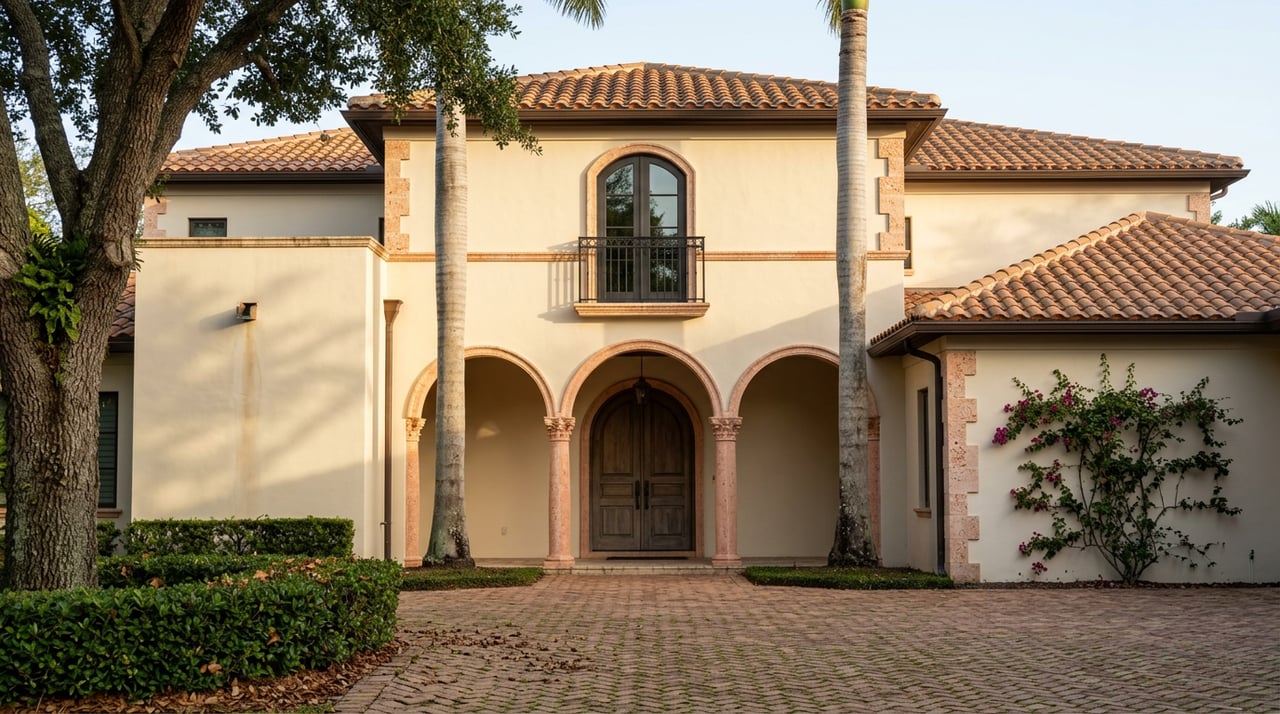
Say you close on a 1930s Mediterranean revival off Alhambra Circle and want to swap the flat-profile windows for something more energy efficient before you move in. You call a contractor, expect a permit in a couple of weeks, and start picking finishes. Then you learn the window swap has to clear the Board of Architects first, and the Board only meets on Thursdays, and your first submittal is likely to come back with revision notes rather than a stamp of approval.
That surprise is common enough in Coral Gables that it deserves an explanation beyond "the city is strict." The strictness is real, but it isn't random bureaucracy. It's built on top of an economic incentive most buyers never hear about, and understanding that incentive tells you more about how this market actually prices homes than any median you'll find on a listing portal.
The Two Economics Hiding Inside One Design Code
Coral Gables' Board of Architects reviews almost any exterior change to a residential property: new construction, additions, paint color, window replacement, roofing, fences, even driveway pavers. Interior work that doesn't touch the exterior envelope skips the Board entirely and goes straight to plan review. That part is straightforward.
The part that surprises people is why so much brand-new construction in Coral Gables still reads Mediterranean, decades after Merrick's original mandate stopped being the only option. The city's Zoning Code doesn't just permit that style. It pays for it. Section 5-200 of the code creates a two-level bonus program, commonly called the Med Bonus, that grants qualifying multi-family and mixed-use projects extra floor area and an additional story once the design clears Board review and meets a set number of Mediterranean design prerequisites.
The Zoning Code defines Coral Gables Mediterranean Architecture as "an architectural style that exhibits George Merrick's vision."
That single sentence is doing more economic work than it looks like. For a developer weighing a multi-family or mixed-use project, choosing the Mediterranean vocabulary isn't a sentimental nod to the 1920s. It's a path to more buildable square footage, which is more revenue. The code makes tradition the financially rational choice, which is exactly why the skyline around the Biltmore corridor and downtown core keeps producing new buildings that look like they belong next to the old ones.
A single-family homeowner gets none of that bonus. If you're renovating a house on a residential street, the Med Bonus doesn't apply to you. You still answer to the same Board of Architects, on the same weekly schedule, with the same expectation that your materials come from an approved list, stucco, coral rock, barrel tile, wrought iron, and your paint color comes from a roughly 60-color approved palette. You carry the compliance cost. The payoff isn't extra square footage. It's a neighborhood that has looked essentially the same for a century, which is a large part of why buyers pay a premium to live in it.
What the Published Median Actually Blends Together
If you've compared home-value estimates for Coral Gables across a few different sites, you've probably noticed they don't agree. Pulling figures from mid-2026, one widely used tracker put the three-month median sale price for all property types at roughly $1.7 million as of June 2026. Another home-value index, updated the same month, put its average figure closer to $1.58 million. A third source, working from single-month closings in July 2026, showed a median sale price around $1.3 million.
That's a spread of roughly $400,000 across three commonly cited figures describing close to the same window of time in the same city. None of those numbers is wrong. They're measuring different things, blended differently. Coral Gables contains condominiums in the $1 million range, original single-family houses in the interior that are frequently renovation candidates, updated postwar and mid-century homes, and waterfront estates with private dockage that trade in the eight-figure range. A single median folds all of that into one line, and depending on how much condo inventory and how many high-end outliers a given snapshot happens to catch, the number moves.
Here's a rough breakdown of how price actually maps to product type and section in Coral Gables right now:
| Price band | What you're typically buying |
|---|---|
| $1M – $2M | Downtown and Biltmore-corridor condominiums, smaller original single-family houses in the interior, often needing renovation |
| $2M – $4M | Updated postwar and mid-century houses in Riviera and interior sections, entry-level positions in the Country Club section |
| $4M – $8M | Larger renovated or newly built houses on premium streets, architecturally significant Country Club section homes, canal homes with dockage |
| $8M+ | Waterfront estates in enclaves like Gables Estates and Old Cutler Bay, where lot size and dock access set the price rather than the median |
The takeaway isn't that any single portal's number is untrustworthy. It's that a citywide median tells you almost nothing about what your budget actually buys until you know which section and which product type you're comparing against.
Why Some Houses Sell in a Week and Others Sit for Months
The segment-by-segment pattern shows up clearly in how quickly individual homes trade. Two closings from early 2026 illustrate the range. A house on North Greenway Drive sold in less than a day. A home on Sorolla Avenue, sitting on a 22,500-square-foot lot just north of Granada Golf Course, closed in January 2026 for $7.8 million after roughly a week on market. Both are premium-street properties that were already aligned with buyer expectations on condition, size, and design.
That speed isn't universal across Coral Gables, even within the same price tier. Homes on strong streets that are turnkey and priced to recent comparable sales tend to move fast, because buyers can see immediately what they're getting and don't need to price in renovation risk or Board of Architects timelines. Homes that need exterior work, or that are priced ahead of what the block has recently supported, sit longer and see more price reductions. The design code doesn't just shape what a house looks like. It shapes how confidently a buyer can act on it, which shows up directly in days on market.
The Renovation Clock You Should Budget Before You Write an Offer
If your plan for a Coral Gables property includes any exterior change, new windows, a repainted facade, an addition, a fence, the timeline belongs in your offer strategy, not something you figure out after closing.
A typical Board of Architects review cycle runs three to eight weeks. Most projects don't clear on the first submittal. Two to four cycles is common, particularly for new construction or significant additions, since the Board frequently asks for revised window proportions, different roof profiles, or a different color from the approved palette. Add plan check on top of that, which runs another six to twelve weeks for structural, electrical, and life-safety review, and a renovation that felt simple on paper can take several months before a shovel goes in the ground. If the property carries a local historic designation, there's an additional Certificate of Appropriateness step layered on top of standard Board review, which follows the Secretary of the Interior's Standards for rehabilitation.
None of this applies to interior renovations that don't touch the exterior envelope. Those go straight to standard plan check.
A few questions are worth asking before you write an offer on any Coral Gables property where exterior work is part of your plan:
- Is the property individually designated historic, or in a designated historic district? That determines whether you're looking at standard Board review or an added Certificate of Appropriateness step.
- What exterior materials and colors does the existing structure use, and do they already match the city's approved palette? Matching reduces the number of revision cycles you're likely to face.
- Has anything similar to your planned scope been approved recently on the same street? Prior approvals aren't binding precedent, but they signal what the Board has been comfortable with lately.
FAQ
Do I need Board of Architects approval to renovate a Coral Gables home? Only for exterior changes. Interior renovations that don't affect the outside of the structure go directly to standard plan review at the city's Building and Zoning department.
Does the Med Bonus apply if I'm renovating my house? No. The Med Bonus under Section 5-200 applies to multi-family and mixed-use development seeking additional floor area and building height. Single-family homeowners still go through Board of Architects design review, but without that bonus incentive attached.
How long should I plan for design review on an exterior project? Budget three to eight weeks per submittal cycle, and expect two to four cycles for anything beyond a minor change. Historic-designated properties add a separate Certificate of Appropriateness step before that clock even starts.
Coral Gables rewards buyers who read it street by street rather than by the number on a portal's homepage. If you're weighing a purchase here, whether it's a turnkey house on a premium block or a renovation project that needs a realistic design-review timeline built into your offer, The Merino Group can walk the comps and the process with you before you're under contract. Let's Connect.